

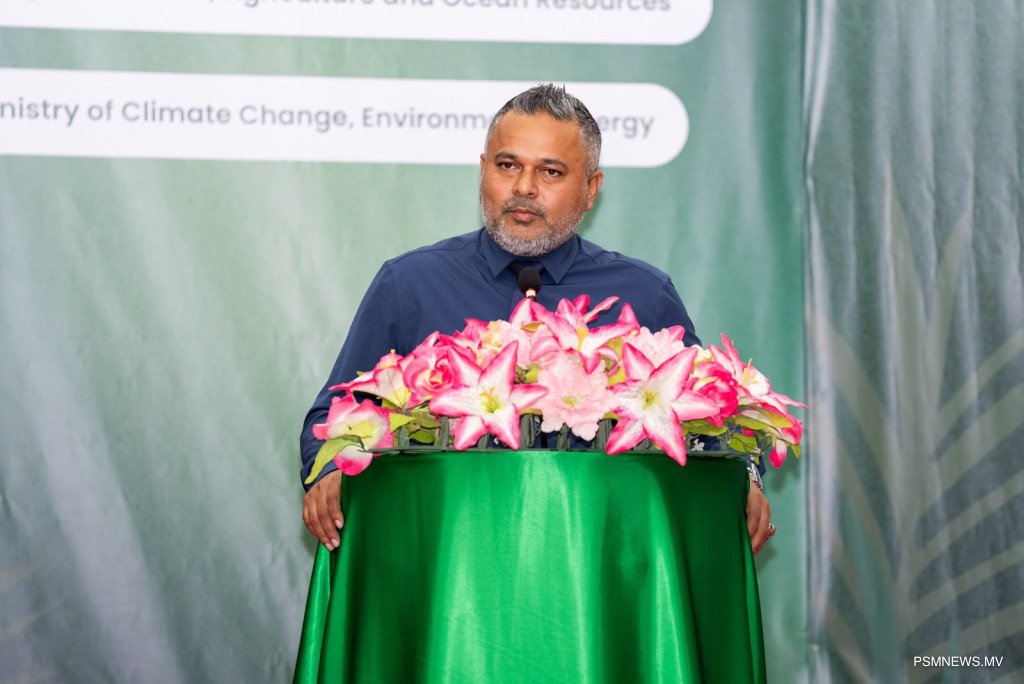
The Minister of Fisheries, Agriculture and Ocean Resources, Ahmed Shiyam has announced that expanding agriculture and empowering farmers with financial and training opportunities is a top priority for the government.
Speaking as the chief guest at a ceremony held in Meedhoo, Addu City to mark the World Food Day and National Farmers’ Day, the Minister said that since assuming the agricultural portfolio, his Ministry has launched extensive efforts to bring revolutionary changes to the sector in line with President Dr Mohamed Muizzu’s vision.
“Much like fisheries, agriculture is a vital industry for our nation and requires special attention and support,” he stressed, noting that the country’s low‑lying island geography makes farming especially challenging.
Minister Shiyam highlighted that while the Maldives faces global economic and climate pressures, the ability to grow crops year‑round remains a significant advantage that can be leveraged for national food security.
The Minister underscored that food security is not merely an economic issue but a cornerstone of national security. To achieve a modern standard of food security, the government will prioritise education, training, modern resources, and financial assistance for farmers.
“We carry a very large responsibility. That is what we are striving to deliver to farming communities as a top priority—increasing the provision of required training, education, resources, and financial assistance to farmers. Fulfilling these needs is our primary objective,” he explained.
Minister Shiyam also pointed out the stark import dependence of the Maldives, noting that over 90 percent of the food consumed is imported. Annual fruit and vegetable imports amount to roughly USD 60 million, including USD 4.7 million on watermelons and over USD 6.8 million on cabbage and lettuce in the past year alone. The government’s policy aims to curb these imports by boosting local production of varieties that can be cultivated domestically, a goal that will require scaling up assistance to farmers, he added.