

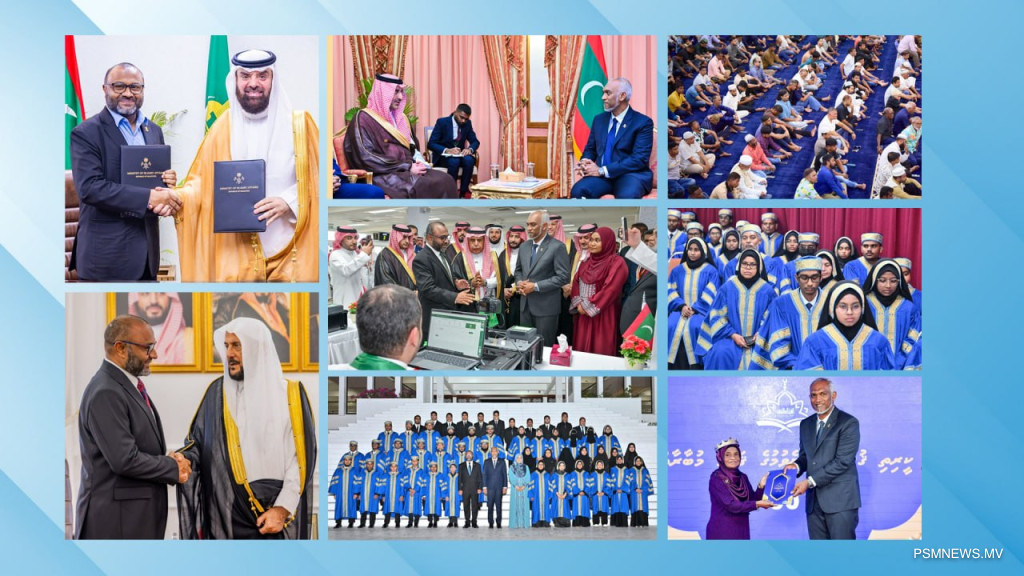
Nine hundred years after the Islamic faith was first established in the Maldives, the delivery of foundational religious education across its dispersed islands has evolved into a structured apparatus of state-assisted programmes. Across the past three years, domestic policy and expanding international opportunities have driven steady progress in religious affairs, culminating over the last two years in a targeted push by authorities to elevate public religious literacy and preserve the country’s standing abroad.
Statutory governance of Zakat
Public awareness surrounding Zakat has long remained a domestic priority, prompting the administration to enact the first dedicated Zakat Act in the country's history to place the religious obligation under statutory governance. Grounded in contemporary Islamic scholarship, the regulatory framework is designed to function with institutional transparency, securing public confidence in the collection and disbursement of Zakat to eligible recipients.
Under the provisions of the statute, all Zakat revenues are deposited into a dedicated account administered by the Maldives Monetary Authority. To refine the management of alms and guarantee disbursements reach verified recipients, President Dr Mohamed Muizzu established the Maldives Zakat House.
Expanding the ranks of Hafizes
Anchoring the state’s religious education initiatives is a nationwide programme to expand the country’s register of Quranic memorisers, guided by the administration’s declared stance that a nation with youth who memorise and cherish the verses of the Quran is bound for success. Under revised national educational criteria, certificates conferred upon Hafizes are now formally accredited by the Maldives Qualifications Authority.
All qualifying graduates, irrespective of their final assessment grade, will receive a dedicated Presidential Medal and state-sponsored travel for the Umrah pilgrimage to foster youth participation. Graduation ceremonies have introduced a distinctive academic gown, accompanied by a doubling of the monthly state allowance for certified Hafizes from USD 129.70 to USD 259.40, fulfilling pledges made by President Muizzu.
State targets call for the graduation of 500 Hafizes during the current presidential term. With 310 certified to date, approximately 2,000 students are actively pursuing memorisation studies across the country.
Youth in the Mimbar
To address an acute deficit of sermon givers across regional atolls, the state has initiated training programmes for local Imams, deploying candidates to domestic courses and foreign Islamic institutions.
Seeking to cultivate a younger cohort of community leaders, the government opened Khateeb instruction to secondary school pupils. Four training rounds have yielded approximately 600 certified youths, many of whom have been authorised to deliver Friday sermons in the capital, Malé, and on outlying islands. Official policy aims to certify 1,000 young Khateebs before the end of the current term.
Endowments and regional infrastructure
Alongside educational initiatives, authorities have concentrated efforts over the past two years on expanding the Waqf sector to establish self-sustaining capital reserves for religious affairs. A specialised Waqf Fund was instituted to finance religious outreach, education, civilisation, religious symbols, and community cohesion, as well as the construction and repair of mosques.
In Malé, construction is progressing on Dar al-Arqam, a 12-storey Waqf complex situated adjacent to the National Centre for Information Technology. A second 12-storey development, Dar al-Salam, is underway in Hulhumalé. Authorities have likewise resolved to erect a specialised Quran Waqf complex on the plot originally designated for the Coral Boulevard project. Across the atolls, regional Waqf developments are advancing in Thinadhoo City, Kulhudhuffushi City, Hithadhoo in Addu City, and Villingili in Gaafu Alifu Atoll, creating a decentralised institutional base across the country.