

President Dr Mohamed Muizzu has said that a system will be established within one month to prevent the diversion of foreign currency without depositing the amount required under the Foreign Currency Act.
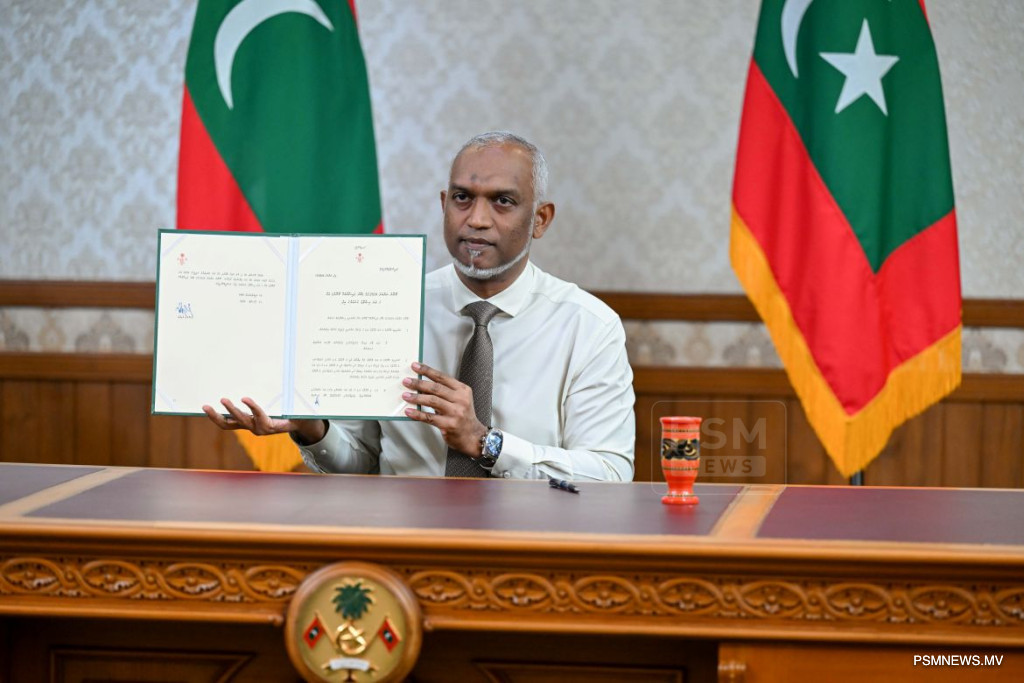
Speaking at a ceremony held at the President’s Office to ratify seven bills passed by the Parliament, President Dr Muizzu assured that his administration would remain committed to implementing the law.
The second amendment to the Foreign Currency Act requires resorts to deposit and exchange 40 percent of their total foreign currency earnings into a bank account established in the Maldives. President Muizzu said some resort businesses had raised concerns that complying with the requirement could make it difficult for them to manage their expenses and affect their income.
He said the amendment was introduced after considering various calculations and conducting extensive studies on the matter. The President also said there was full assurance that no resort operating in the Maldives would be unable to operate as a result of the 40 per cent requirement.
Explaining the reasons behind the amendments requiring foreign currency to be exchanged, President Muizzu also shared several statistics.
He said the tourism industry generates more than USD 5.6 billion in annual revenue for the Maldives, while an estimated USD 3.8 billion enters the country’s banking system. Of this amount, only 21 per cent is exchanged through banks, he noted. Before the introduction of the Foreign Currency Act, only around 10 per cent was exchanged through the banking system annually.
“There may have been ways in the Maldives to manipulate the system and get away with it. We will not provide an opportunity for that. Within one month, we will officially have systems in place that will allow us to know where a tourist went after entering the Maldives, where they went, where they stayed and when they left. There will be no opportunity for manipulation,” the President said.
President Muizzu also said the government would not delay in implementing the provisions of the Foreign Currency Act and ensuring that the rights of the people are protected. He pledged that the administration would continue working in the interests of the public when making government decisions.
The President said the amount of foreign currency held by banks has declined because some of the money entering the Maldives does not enter the banking system, while some foreign currency is exchanged through the black market outside formal banking channels.
As a result, businesses that need foreign currency are forced to purchase it on the black market, driving up the prices of goods, he said. He added that foreign currency needed for essential purposes was also being withheld to a certain extent.
The government’s objective, he said, is to introduce solutions to the issue alongside the amendments to the relevant laws, ensuring that people can obtain foreign currency at the rate set by the authorities.
The government is also introducing further amendments to legislation to address foreign currency flows from the tourism sector that do not enter the banking system.
Under an amendment to the Payments System Act, businesses providing services in the Maldives will be required to charge for those services through a point-of-sale (POS) machine operated by a bank established in the Maldives.
In addition, the government is introducing measures to collect GST on goods and services provided by overseas-registered tour operators, travel agents and other booking platforms operating in the Maldivian tourism industry.