

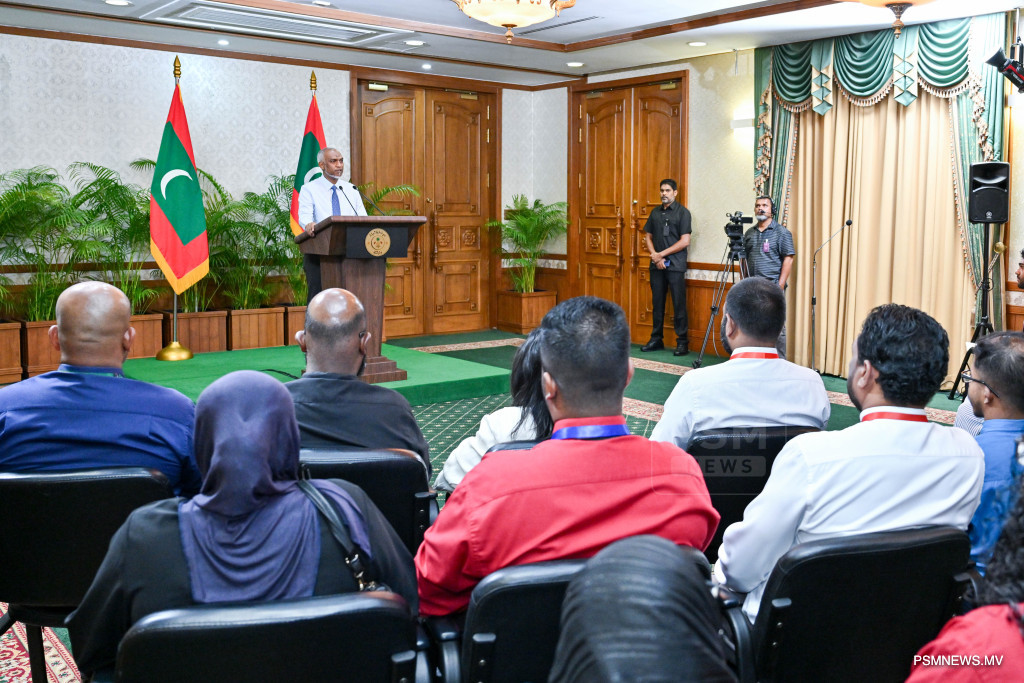
President Dr Mohamed Muizzu has outlined a wide-ranging strategy to mitigate the economic impact of the ongoing Middle East conflict, while announcing a series of domestic legal, social and institutional reforms.
Speaking at a press conference on 23 March, President Muizzu said energy security remains a key priority amid volatility in global oil markets. He announced plans to establish a national strategic oil reserve, to be developed in three phases across different regions of the country over the next two years.
“The establishment of this oil reserve is very important. It is like the Sovereign Development Fund, but it will be in the form of an oil reserve,” he said, describing it as a safeguard to ensure uninterrupted fuel supply.
The President also assured that there is no shortage of essential goods, stating that adequate stocks of rice, flour and sugar are being maintained, with prices remaining stable. To strengthen long-term food security, he said special incentives will be introduced to encourage private sector investment in local food production.
On domestic reforms, President Muizzu announced planned legal and constitutional changes, including revisions to housing inheritance rules under social housing schemes.
“Currently, if you have less than 400 square feet of land, you have to give it up to the state when you qualify for social housing. The rule will be changed so that you can leave it to your spouse or children or siblings,” he said.
In a significant judicial development, the President said a special bill will be submitted to parliament during the current session to facilitate the implementation of the death penalty, stating that it is not an option for the leader of a Muslim nation to neglect its enforcement once all legal procedures have been completed.
Electoral reforms were also highlighted, with proposals to cap the number of Members of Parliament regardless of population growth, and to introduce quotas for youth under the age of 30 and for women. The administration is also studying the introduction of a preferential voting system for presidential elections, as well as fixing the presidential term start date to 11 November.
Further reforms are aimed at strengthening the independence of state institutions and the judiciary.
The President also confirmed that the Citizens’ Complaints Bureau, announced in his presidential address in February, is progressing and is expected to be established in July.