

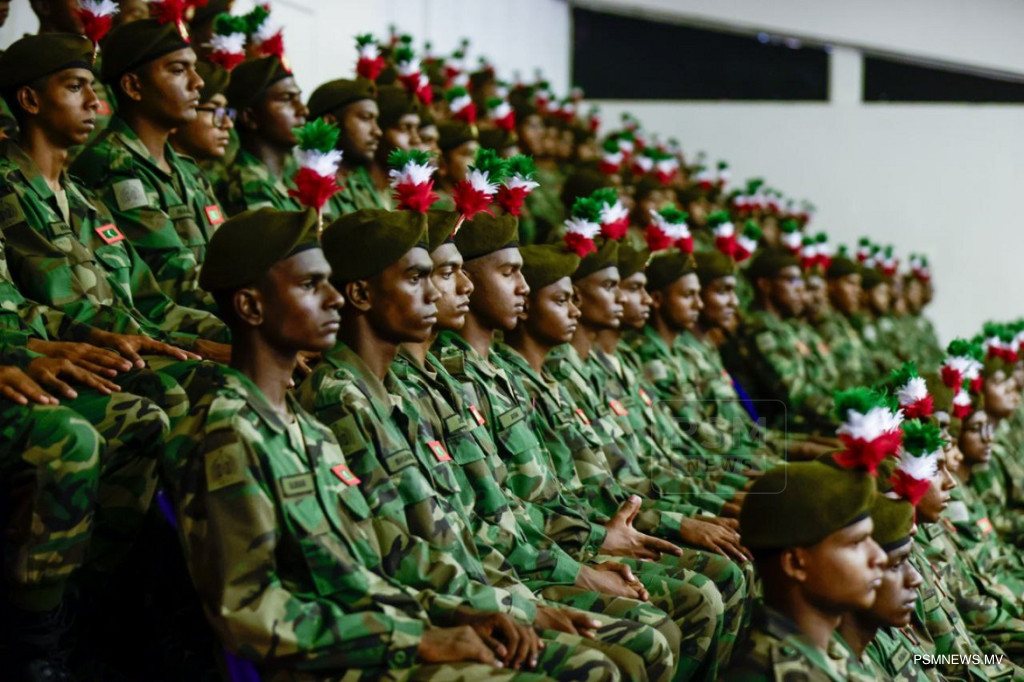
The government has submitted legislation to Parliament that would confer formal legal authority on the National Service programme, an initiative first introduced last year by President Dr Mohamed Muizzu.
The bill, presented on behalf of the administration by Faruhath Mohamed, the Parliamentarian for South Kulhudhuffushi, is intended to establish a comprehensive legal framework for the programme. Its stated purpose is to cultivate a generation of young Maldivians who are physically, technically, and intellectually prepared to contribute meaningfully to both the nation and society.
The proposed legislation requires the government to conduct a programme comprising a basic education and training course, followed by a period of service within a state uniformed body. It specifies that the programme must be designed to nurture youths who respect the Islamic faith and its symbols, take pride in their country, and place national identity at the forefront of their values.
Eligibility would extend to youths between the ages of 16 and 21. For those under 18, participation would require parental consent as well as the explicit willingness of the child. Prospective participants must also complete and pass a medical assessment, with standards to be defined in regulations issued under the law.
The bill places responsibility for logistical and financial support with the Ministry of Defence, which would cover accommodation, meals, medical care, and transportation during the training period. Participants would also receive a financial allowance deemed reasonable under the legislation. Once the basic education and training components are completed, they would be required to serve in a uniformed body for a period not exceeding one year, with the specific terms determined by a Governing Council. The bill further provides that, following this service, opportunities would be facilitated for participants to pursue employment within the uniformed services.
Oversight of the programme would rest with a high-level Governing Council composed of senior officials, including the Minister of Defence, the Minister responsible for Homeland Security and Technology, the Minister of Finance, the Chief of Defence Force, and the Commissioner of Police. The President of the Republic would serve as President of the Council, while the Minister of Defence would act as Vice President.